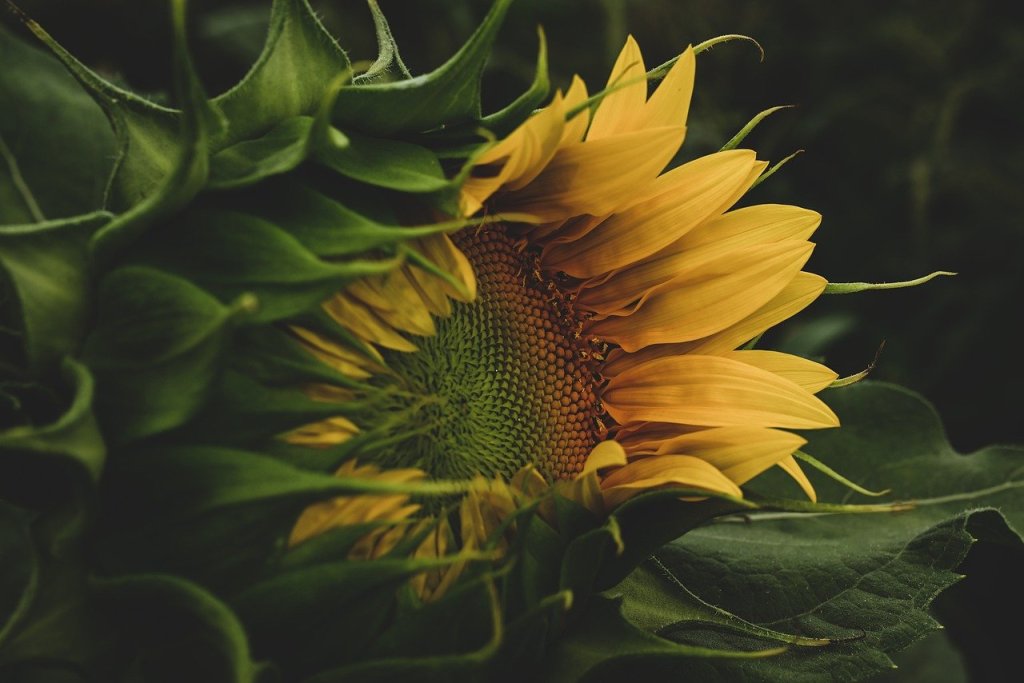
The sunflower waved in the wind, its heavy head rocking back and forth like a metronome. The yellow petals were slowly unfurling from its darkened face, like someone slowly stretching in the morning. She watched the flower out of the window, the tea cup she held halfway to her mouth forgotten as she sat mesmerized by the flower’s dance.
“Did you hear me?” The harsh voice broke through the stillness.
The young woman shook her head to break out of the trance. Her eyes caught a stooped figure standing in the doorway. She frowned. “I thought I told you to go away.”
The figure shuffled forward. The ancient woman was dressed in a faded flower dress, with wispy curling gray hair and dark beaded eyes. Clawed fingers curled around the top of the twisted oak branch that served as a cane. “You can’t ignore me forever.”
“I can and I will.” The young woman turned back to the flower.
“The time has come. The moons are joining. If we do not-“
“If we do not, nothing happens to me.” The young woman snapped. She slammed down her cup, tea splashing onto the white table. She stood, eyes blazing, long black hair crackling around her. The air popped and snapped.
The old woman merely studied her with a steady eye. “You lose control too easily.”
The young woman’s lips thinned into a sneer, her eyes growing cold. “And you are too weak. What does it matter? Why does any of it matter?”
She turned to look out of the window. “Perhaps it is time for the old powers to die.”
“You would really give up that easily?” The old woman laughed. “What would your pretty house and garden be without your powers? What would you be?”
The young woman smiled, lost in thought as she traced her finger through the spilled tea. It shimmered and shook and started reforming into the outline of a sunflower. “I said perhaps it was time for the old powers to die. I said nothing about my powers.”
A look of dread dawned in the old woman’s eyes. “What have you done?”
“What our kind should have done centureis ago. No more hiding. No more shame.”
“Him?” Her body shook. “You made a deal with him? Why?”
The young woman smiled and looked out of the window. “He promised me a whole world of sunflowers. Don’t you think that would be pretty?”
AFTER THE STORY
This story was really fun because I had absolutely no idea what I was doing the entire time I was writing it. It really just started with describing the sunflower. Then I was picturing a sunflower outside of a window. Someone sitting at a table drinking tea watching the sunflower. But where would the plot be? What would drive the character? What was she thinking?
The story really just flowed out sentence by sentence. I’m not really sure why all my stories tend to go in the fantasy/sci-fi realm other than that’s what I love to write. Which makes it really fun to take ordinary objects, like sunflowers, and try to figure out how to make it magical/mystical. How do I twine something like a sunflower into a fantasy world?
Sometimes when I’m looking at my prompts, whether words or pictures, the whole story just blossoms the moment I see it. Others, like this one, evolve sentence by sentence, the story unfolding like a piece of parchment paper.
This was a really exciting way to write, as it was a surprise even to me. Crafting the story was like unwrapping a gift. However, when re-typing this (since I write these stories first on a pad of paper) I had a really hard time not editing the story. I realized as I re-read it that I had missed out on some key information to put you, the reader, into the story. Like I never placed the woman as sitting down staring out the window. Then all of a sudden she’s standing up. Standing up from where? That is one of the drawbacks of the scrolling story. As you add elements, you need to go back and make sure that the earlier story has the foundation to support the new elements.
This is really a lesson in how I actually write. When I first wrote Planetary Feedlot, I had just a general outline of the story and the characters. But as I started writing each chapter, the story and the characters evolved, much like the scrolling story. A new thought or question or element would pop in my head. Why would they do this? What if they did that? What if this was their actual motivation? What if I twisted this this way?
It was hard trying to keep track of all the new elements and building foundations for them. But that’s what editing is for. And even after, I realized there were some things that might have gotten missed, at least in my eyes. But that’s what’s so great about writing: the constant learning and growing. Honing my craft. The lessons I learned on my debut novel will go towards making my next novel even better.
For the next book, I took a lot more time thinking out my outline and my characters. I created a Plot Book to hold all of them, and also as a place to take notes as I write. Because even with all the pre-planning I did, I still find myself writing a scrolling story. So, when a new element pops up or an old element gets dismissed because it really doesn’t work, I now make a note in my notebook. That way, when I edit, I can make sure that the earlier story supports the later element additions and subtractions.
A lot of the times we read books expecting authors to be fully formed and polished. I think that’s a part of why I resisted finishing my books for so long. Because once it was finished, I would have no resistance to publishing it, where anyone could read it. I was afraid of people not liking it. But as I’ve done these stories, these blog posts, and getting the initial reviews of my book, I’ve realized that there will always be negatives. Some are just people who want to watch the world and other people burn because, well, they are just nasty negative people with no hope in their life. But for the good negatives, the constructive criticism, those things help me become a better writer. And learning really is a fun part of this journey. I love doing these 15 minute story exercises because not only is it a way to take 15 minutes just to let my imagination explore some random topic, but I always learn a little bit about my writing on the way.
Where would you take this story? Have you tried your own 15 minutes stories yet?
 E.R. COOK
Leave a comment